

Being a young adult in the current political and socio-economic climate is a tough gig. One can graduate with top honours from a first-rate university and fail to enter the job market for a prolonged period of time. Seldom a result of one’s merits or talents, it is a reflection of the stifling job market. Many employers have decelerated recruitment amid economic uncertainty and misjudged political decisions, and those graduates who do have jobs are facing much higher effective marginal tax rates due to student loan repayments. More broadly, higher housing costs and soaring daily expenses have not been matched by wages, with the gap seemingly ever widening. Furthermore, advancements in AI are rapidly changing the fabric of the UK workforce – who knows where we will be in ten, maybe even five, years’ time.
All the more reason then, one could argue, to bolster your personal finances long before you even consider retiring. For people in their twenties (like myself), the prospect of the state helping secure a minimum living standard when we’re in our seventies seems unlikely. I know many who plainly believe they will never retire and will be working till they drop. One can never be sure of how the world will look in 2076; the reality is unlikely to be as drastic as some fear. Regardless, starting to invest at a young age is a great way to build up significant wealth and decrease one’s reliance on the state. This is largely due to the effects of compounding growth.
Perhaps a simpler way to think of compounding is to refashion it as ‘the snowball effect’. As the graph below demonstrates, starting 15 years earlier (aged 20 instead of 35) could result in £450,000 more – despite net deposits over those 15 years totalling £75,000 – by the time one reaches 65.
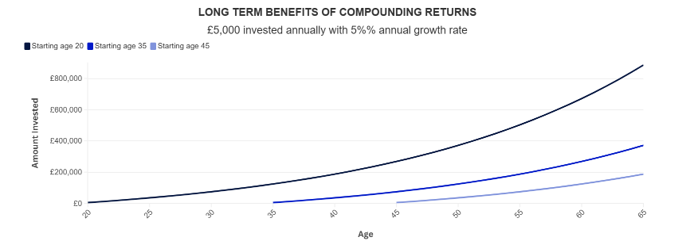
Source: Rathbones ‘Investing early and often: the magic of compound interest’ (15th Jan 2025)- Investing early and often: the magic of compound interest | Rathbones
Additionally, as the below graphs illustrate, the younger one starts, the less one needs to commit financially. The investment growth does the job, not the individual. Therefore, not only is it extremely likely one will have more money the earlier one starts; it also makes the journey much easier, as you are allowing equity markets to do what they have historically done, that is generating long-term capital return.
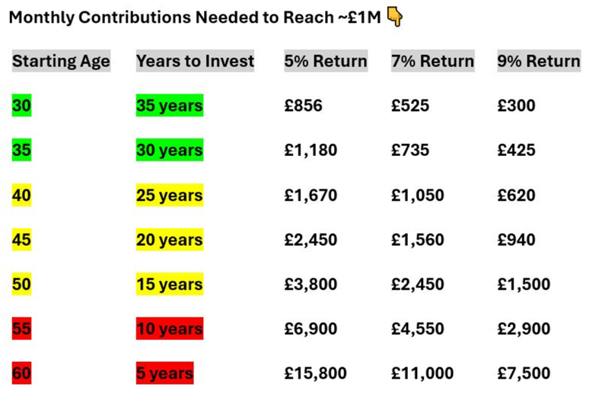
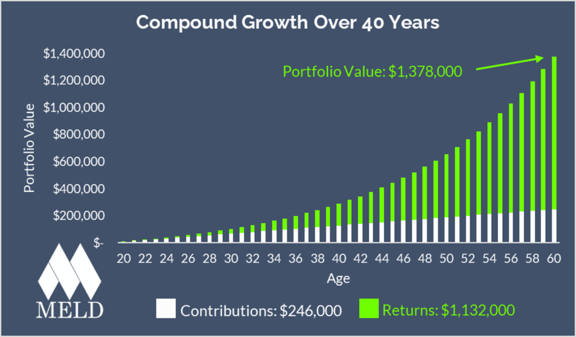
Source: Meld Financial ‘The Power of Compound Growth in Your Portfolio’ (9th May 2024)- The Power of Compound Growth in Your Portfolio – Meld Financial
To many younger folks like myself, the prospect of having £5,000 spare to invest every year is wildly beyond our current reach. While compounding is more impactful on larger sums, thankfully it is not selective. Starting now by contributing £25 or £50 a month into a Stocks & Shares ISA, that is invested across a diversified range of assets and countries, will have a meaningful difference over the long term. Most young people I have spoken to don’t feel adequately prepared to begin their investing journey. Investing and personal finance is underexplained and undervalued across all generations, not just amongst young people. However, taking the time to familiarise oneself with basic terms, with how the market works, and how one is likely already invested in the stock market without realising it through their workplace pension, we can begin to turn the dial, and help younger people secure their futures in an increasingly insecure world.
Disclaimer:
All the above information is provided as information only and any examples used are not indicative of financial advice to address your particular requirements. The information does not constitute any form of advice or recommendation by Melville Independent plc, and is not intended to be relied upon by readers in making any financial decisions. Melville Independent Plc is an Appointed Representative of JKFS (UK) Ltd which is authorised and regulated by the Financial Conduct Authority. The Financial Conduct Authority does not regulate taxation advice.

By Logan Breckon
Adviser Support
July 2026

